Memorial Day of the Venerable Martyr Theodosius of Constantinople
Celebrated on 11 JuneOn June 11, the Orthodox Church celebrates the Day of Remembrance of the Venerable Martyr Theodosius, who lived in the 8th century in Constantinople.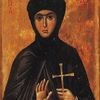 The saint became famous as the intercessor of the purity of faith and defender of images in the era of cruel iconoclasm.
Theodosia was the only daughter of wealthy parents who remained childless for a long time. After numerous prayers, the Lord gave the pious but childless couple a long-awaited child. In gratitude, the girl’s father and mother promised to dedicate their daughter to the service of God.
At the age of 7, Theodosia began to live at the monastery of St. Anastasia, and after another 3 years, having become an orphan, she took over her parental inheritance. Having reached adulthood, the girl donates the estate and wealth of the monastery bequeathed to her, and asks to cast icons with the faces of the Savior, the Mother of God and St. Anastasia from gold and silver. Precious images become decorations of the monastery church.
Theodosia was distinguished not only by her unselfishness, but also by her meekness of character and zeal in prayer. The devil knew that her faith was strong and her soul was pure, but he wanted to bring confusion into the nun’s mind. Appearing to Theodosius, he boasted that he had found a man with whose help many would turn away from the worship of holy icons. The nun did not want to believe the words of the vile man, but soon she had to witness bitter events.
Leo Konon, who ascended the throne of Byzantium, ordered the fight against icon veneration in all Orthodox churches. All images were destroyed, equated to pagan idols. For hundreds of years, the gates of Constantinople were crowned with a copper icon depicting Christ. Theodosia and other nuns came to protect the image of God. By not allowing the atrocity to happen, the women brought upon themselves the royal disfavor. The greatest anger of the ruler fell on Theodosia, as the instigator of the rebellion against the royal decree. For several days, the nun was taken around the city, beaten, and thus tortured to death. Sympathetic Christians picked up the saint's body and buried it in a special place. The miraculous tomb of Theodosia has become a place of pilgrimage for many asking for healing and God's mercy.
In folk tradition, the day of Feodosia was associated with the flowering of ears of corn. On Kolosyatnitsa the first mushrooms appeared, and it was time to sow buckwheat. Cattle were given special treats, and homemade ritual baking was supposed to contribute to the appearance of healthy offspring. On June 11, it was possible to accurately predict the price of rye. To do this, they carefully examined the ear. Flowering in its lower part indicated cheap grain, and in the upper part - expensive. Flowering in the middle of the ear indicated an average and stable price.
Other holidays on 11 June
- Funny holidays - Day of Indomitable Passion
- International holidays - Light Industry Workers Day
- International holidays - International Naturist Day (Nudist Day)
- International holidays - Jacques-Yves Cousteau Day
- All-Russian Multiple Sclerosis Day
- Holidays of the Slavs - Peter's spell
- Holidays in Belgium - Father's Day
- Catholic holidays - Saint Barnabas' Day (Feast of Saint Barnabas)
- According to the folk calendar - Feodosia Kolosyatnitsa
- US Holidays - King Kamehameha Day in Hawaii
- Feast of the Icon of the Mother of God “Watching Eye”
- Feast of the Icon of the Mother of God of Mateliki (Metelinskaya)
- Feast of the Tsesar-Borovskaya Icon of the Mother of God
- Memorial Day of St. Luke Voino-Yasenetsky
- Memorial Day of Saint Righteous John of Ustyug, Christ for the Fool's Sake
- All Saints Cathedral