Pagan holidays - Imbolc
Celebrated on 1 FebruaryImbolc is one of the ancient pagan holidays of the Irish Wheel of the Year.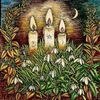 Its date is associated with the lunar calendar and is not strictly fixed, but traditionally the holiday is celebrated on February 1. Imbolc stands on the border between the harsh winter cold and the approaching warmth; for farmers it is the arrival of an agricultural spring. It was February that was the time of preparation for future sowing. Hence the custom of putting homes and households in order, inspecting and shaking out all household utensils, and washing pets.
Candles were always lit for the holiday. The more candles the better, and they could burn all night. Another custom associated with fire was coming to snowy fields with lit torches. The area was illuminated, going around from all sides, indicating the imminent sunny days and melting of the snow cover.
The name of the holiday Imbolc is of Celtic origin and means "sheep's milk". Livestock (and in Ireland these are mainly sheep) by this time had offspring, and milk became the most accessible raw material from which a variety of dishes were prepared. The festive treat consisted mainly of baked milk, milk porridge, young cheeses, and herbal drinks with added milk. Also on the holiday it was necessary to bake bread and churn butter.
Many holidays of the Irish wheel of the year were associated with the goddess Brigid, who was either a young girl, or a mature woman, or an ancient old woman. Her symbol for Imbolc was a woven straw cross with three or four arms. Brigid was responsible for many functions; she patronized storytellers and bards, crafts and household chores, and was involved in medicine.
At Imbolc, Brigid was a young maiden, ready to fall in love and conceive a new life. There was a custom of weaving a figurine of a goddess and a crib for her out of straw. In some villages, they chose the most beautiful girl for the role of the goddess, dressed her up and took her from house to house, and then laid out a symbolic marriage bed for her in the largest house.
In Christianity and some pagan traditions there are holidays similar to Imbolc. It can be compared to the Orthodox Meeting or Maslenitsa. There is no direct evidence, but most likely the custom of predicting the weather by the behavior of a groundhog on February 2nd also has roots in an ancient Irish holiday.
Other holidays on 1 February
- Russian Holidays - Elevator Worker's Day (Elevator Operator's Day)
- Funny Holidays - International Dessert Day
- Funny Holidays - Robinson Crusoe Day
- Funny Holidays - No Politics Day
- Funny holidays - International Body Art Day
- International holidays - World Hijab Day
- Fun Holidays - Change Your Password Day
- US Holidays - National Freedom Day
- According to the folk calendar - Macarius Day, Makar is the spring pointer
- UN Holidays - World Interfaith Harmony Week
- Day of enthronement of His Holiness Patriarch Kirill of Moscow and All Rus'
- Day of St. Macarius the Great, Egyptian
- Memorial Day of St. Savva of Storozhevsky, Zvenigorod
- Memorial Day of St. Mark of Ephesus