Distaff Day
Celebrated on 7 JanuaryDistaff Day is an unofficial Catholic holiday that falls on January 7 and marks the resumption of work after Christmas.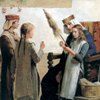 This holiday has its roots in the Middle Ages, and it has not lost its relevance to this day.
Not so long ago, yarn intended for knitting and weaving was not bought, but made independently. The most common raw material for homemade threads is sheep's wool. The spinning wheel is an ancient device with an extremely simple structure. At the same time, the thread turned out to be beautiful, even and strong. Women spun both alone and in large groups, gathering for gatherings on autumn and winter evenings. Therefore, for many women it was important that the instrument looked beautiful and elegant.
Spinning technology has a fairly long history. First, the thread was twisted with your fingers. Then the spindle and spinning wheel were invented. The production of thread has become a continuous process and has accelerated significantly. The first to appear were hand-driven spinning wheels, later - foot-driven ones. Improvement of the device made it possible to regulate the thickness of the thread and improve its quality. For the first time such a device was made in Ancient Rome.
Further steps in improving this instrument were taken by Jurgens of Braunschweig. The product was launched using a foot drive. Both hands were involved in the process, which greatly simplified the work. The spindle was driven by a large wheel. Both parts are connected via a block. The advantage of this invention is the ability to simultaneously perform three operations at once: twisting, pulling and winding threads. The fully mechanized spinning machine was invented in 1741 by J. White. The famous “Jenny”, equipped with eight spindles, also entered the history of the spinning wheel.
Not only the spinning technology as such developed, but also the drive device. At first, donkey traction was used, then steam and finally electric. The electric motor has found application not only in industrial, but also in household models.
Despite its foreign origin, the spinning wheel took pride of place in the Russian hut. Antique products, which can often be seen in ethnographic museums, are real works of art. Each product is unique, decorated with inscriptions and intricate decor. It is believed that traditional wood carving originates from the manufacture of spinning wheels.
The spinning wheel accompanied the woman literally from the cradle throughout her life. The umbilical cord of the newborn was cut on a spindle, and the same object was placed in the cradle. It was believed that this helps ward off evil forces.
Many spinning wheels were “named” - signed. It was impossible to give such an item to another person to use. The best gift from the groom to the bride was a hand-made spinning wheel, decorated with patterns, signed with the name of the betrothed. This meant a firm intention to marry the girl.
It turns out that the spinning wheel is not only a working tool. It also took part in entertainment. Riding the bottom of a spinning wheel down an ice slide is a common pastime during Maslenitsa. There is an interesting belief associated with this entertainment. The further you can travel, the longer the flaxes will grow.
For many peoples, a spinning wheel is one of the key attributes of everyday life. Today these products are valued as antiques. Each of them has its own, interesting story in its own way.
Other holidays on 7 January
- Congratulate the Orthodox on Christmas →
- Victory Day over Napoleon Bonaparte
- Festival of the Seven Herbs (Jinjitsu) in Japan (Jinjitsu, Nanakusa no sekku)
- International Silly Walk Day
- Ski trail untangling day
- Catholic Baptism of the Lord
- Day of Banking and Financial Workers in Belarus
- All Souls' Day in Armenia (Merelots)
- Saphala Ekadashi in India
- Victory over Genocide Day in Cambodia
- According to the folk calendar - Christmas